
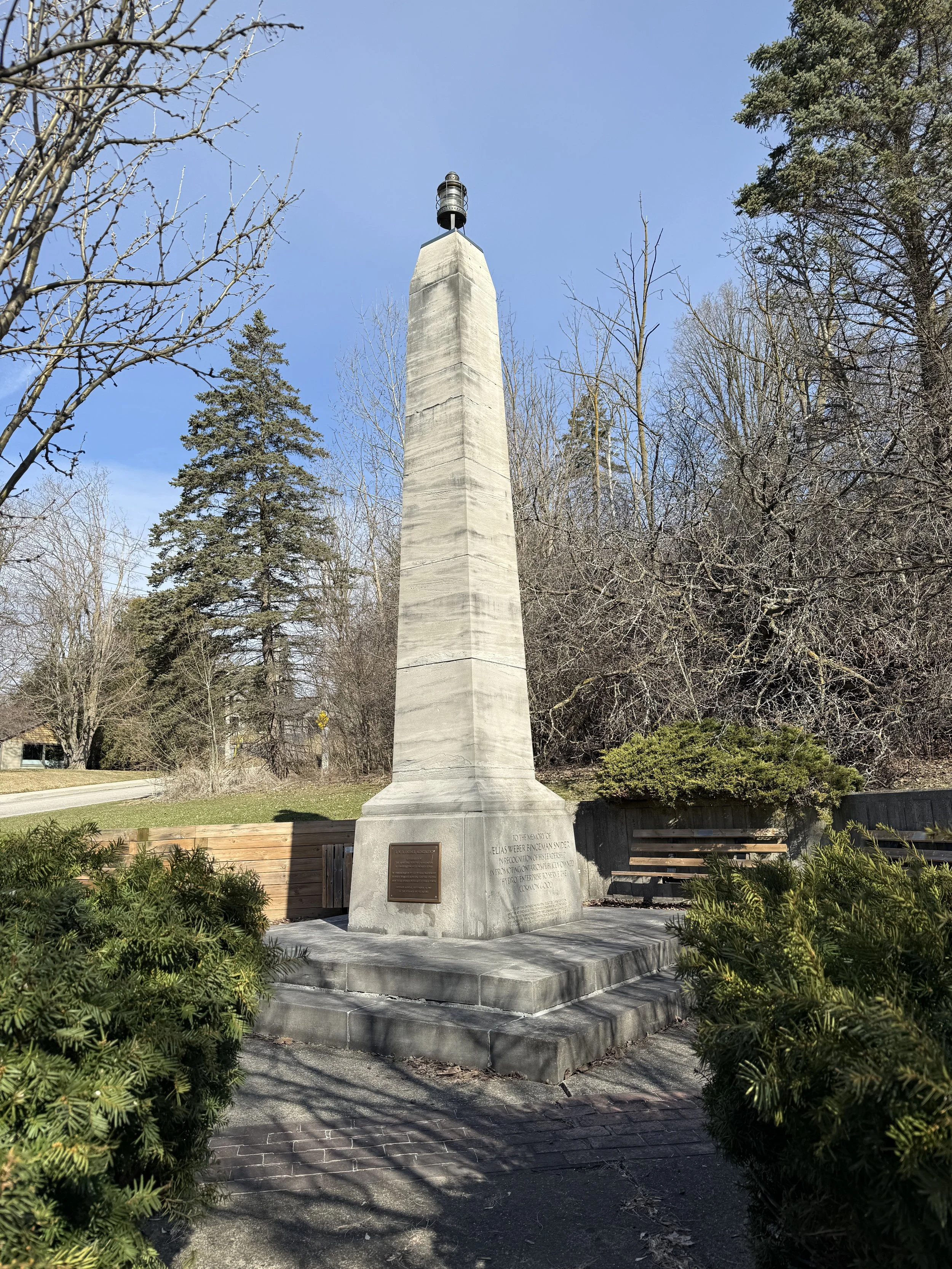
THE ELECTRICITY MONUMENT
Location: Park at the North/West corner of King St. and Northside Drive
Elias Weber Bingeman (E.W.B.) Snider (1842–1921) was one of St. Jacobs' most influential citizens and a pioneer in the development of hydroelectric power in Ontario. A successful mill owner, industrialist, and Member of Provincial Parliament, Snider purchased the St. Jacobs flour mill in 1871 and transformed it into one of Canada's leading milling operations. Recognizing the potential of the Conestogo River as a source of renewable energy, he installed a hydroelectric generator at the mill in 1894. The generator powered the mill's machinery, and when surplus electricity was available, it was supplied to homes and businesses in the village. At a time when most rural Ontario communities still relied on oil lamps and coal, St. Jacobs was among the earliest small communities in the province to benefit from locally generated hydroelectricity.
Snider believed that affordable electricity should be available to every community—not just large cities or private industries. In 1903, he became the first chairman of the Ontario Power Commission, leading a study into the feasibility of distributing hydroelectric power from Niagara Falls to municipalities across Ontario. Working alongside community leaders including Daniel B. Detweiler and Sir Adam Beck, Snider helped lay the groundwork for Ontario's publicly owned hydroelectric system. Their recommendations ultimately led to the creation of the Hydro-Electric Power Commission of Ontario in 1906, establishing a model of publicly owned electricity that would become a defining feature of the province.
St. Jacobs continued to be a leader in electrification. In 1917, the community became the first small village in Ontario to receive hydroelectric service through the Hydro-Electric Power Commission of Ontario.
The monument overlooking the Conestogo River honours E.W.B. Snider's remarkable vision and leadership. From pioneering local hydroelectric generation at the St. Jacobs mill to helping shape Ontario's public hydro system, his work left a lasting legacy that extended far beyond the village. More than a century later, his contributions continue to be recognized as an important chapter in both St. Jacobs' history and Ontario's story of innovation and public infrastructure.
Continue your journey by following the map below to Stop 2: The Mill, located at 1441 King Street North.
The Village of St. Jacobs Historical Trail
Self Guided Walk
Explore the History Walk by selecting each stop on the map below.