HISTORY WALK

St. Jacobs Historical Walking Tour

As you walk these streets today, it’s easy to be charmed by the shops, cafés, and quiet village atmosphere—but St. Jacobs has a much deeper story to tell.

This village began in the mid-1800s as a small service centre for surrounding farms, shaped by early settlers, skilled tradespeople, and a strong Mennonite community. Blacksmiths, shoemakers, millers, and merchants built their businesses here, often living and working in the same buildings you see today.

With the arrival of the railway in 1891, St. Jacobs became more connected to the wider world, allowing local industries to grow. In the early 20th century, businesses like the O.J. Smith Shoe Company brought manufacturing and employment to the village. Later, visionaries such as Milo Shantz helped guide St. Jacobs into a new era, transforming it into one of Ontario’s most recognized rural destinations while preserving its historic character.

This walking tour invites you to step into that history. Each stop reveals a piece of the village’s past—from early industry and family life to entrepreneurship and community transformation.

Take your time, look closely, and imagine the people who lived and worked here before you. Their stories are still written in the buildings, the streets, and the landscape around you.

Land Acknowledgement

INDIGINOUS HISTORY

Long before the founding of St. Jacobs, this region was part of the traditional territory of the Anishinaabe, Haudenosaunee, and Neutral peoples.

The Conestogo River and surrounding watershed formed an important part of a vast network of travel routes, fishing grounds, hunting areas, and seasonal camps. For thousands of years, Indigenous communities lived in relationship with this land, guided by knowledge systems that supported sustainable use of the river and its ecosystems.

The Neutral Nation (Attawandaron) were among the earliest known inhabitants, later followed by Haudenosaunee presence after the 1600s. The Grand River watershed, which includes this area, remains closely tied to the Six Nations of the Grand River today.

European settlement in the early 1800s transformed the landscape through farming, mills, and dams, reshaping waterways and access to the land. This stop acknowledges the deep and continuing Indigenous history of this place.

THE CONESTOGA WAGON

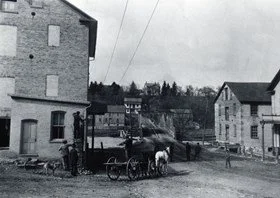
The Conestoga wagon was one of the most important early forms of freight transport developed in this region, and it played a key role in the movement of goods through St. Jacobs and the broader Waterloo County area during the 18th and 19th centuries.

Designed by German-speaking Mennonite settlers in the Conestoga River region of Pennsylvania—and later used and refined in Upper Canada—the wagon was built for heavy hauling over rough terrain. Its distinctive curved floor helped keep cargo from shifting, while its high, bowed canvas cover protected goods from weather. Large wooden wheels and a strong frame allowed it to carry substantial loads of grain, flour, and manufactured goods between farms, mills, and emerging towns.

In this region, Conestoga wagons became essential to the early economy, connecting rural producers to markets and supporting the growth of settlements like St. Jacobs. Though eventually replaced by rail and modern transport, the wagon remains a lasting symbol of early rural trade and Mennonite settler industry in Waterloo Region.

THE MILL

This location stands on the historic site of Jacob C. Snider’s original mill complex and dam, one of the earliest industrial developments in St. Jacobs. Around the early 1850s, Snider—an early Mennonite settler originally from Pennsylvania—constructed a dam on the Conestogo River and built a sawmill, flour mill, and woollen mill powered by water. This industrial hub helped shape the growth of the village, attracting settlers, tradespeople, and commerce to the area.

Born in 1791, Snider settled in Waterloo County in the early 19th century and became a key figure in its development. The village of St. Jacobs—originally known as “Jakobstettel” or Jacob’s village—was named in his honour.

After a fire destroyed the original wooden mills in the early 1860s, the complex was rebuilt in 1862 in more durable stone, marking a shift toward more permanent industry along the Conestogo River. Though the mill has changed over time, this site remains a cornerstone of St. Jacobs’ industrial and community history.

THE FARMERS INN

Joseph Bechtel Eby (1821–1901) was a Mennonite innkeeper and early community figure in St. Jacobs who played a central role in the village’s social and commercial life. In 1852, he built an inn on this site known as the Farmers Inn, serving travellers, farmers, and merchants moving between nearby settlements and rural routes. As St. Jacobs grew, the inn expanded and later became known as the Dominion Hotel, a name it carried into the late 19th and early 20th centuries.

For more than 150 years, this location has remained a place of hospitality, food, and gathering, reflecting the village’s long tradition of community connection. While the building and its businesses have evolved over time, its role as a welcoming stop for residents and travellers has remained constant since Eby first established it in the mid-1800s.

THE ELECTRICITY MONUMENT

Elias Weber B. Snider (1842–1921) was a pioneering industrialist, inventor, and politician who played a major role in the growth of St. Jacobs and Waterloo County.

Born into the Snider family of early Mennonite settlers, he carried forward the milling legacy begun by his father, Jacob C. Snider. Elias is best known for introducing roller milling technology to Canada, a major advancement that modernized flour production and increased efficiency in grain processing. He also helped develop early hydro-power systems in the village, continuing the use of the Conestogo River as a source of industrial energy.

Beyond industry, Snider served in public life as a Member of Provincial Parliament, representing local interests in government. His contributions helped bridge early water-powered industry with modern industrial methods, shaping St. Jacobs’ transition from a small milling settlement into a forward-looking rural centre. The monument across the river commemorates his lasting impact on the region.

THE SCHOOLHOUSSE

This building began its life in the late 19th century as a one-room schoolhouse serving the children of the surrounding St. Jacobs farming community. Built during a period when rural education in Waterloo County was organized through small “school sections,” it provided basic instruction in reading, writing, arithmetic, and practical life skills for local farm families, many of whom were Mennonite and early European settlers in the region.

For more than half a century, the schoolhouse was a central part of daily community life, where generations of children learned together in a single classroom setting. As education in Ontario became more centralized, rural one-room schools were gradually replaced. In St. Jacobs, this transition led to the construction of Queensway Public School in the early 1960s, consolidating local students into a modern facility.

The former schoolhouse was later preserved and adapted for new cultural use, and today operates as the Hildebrand Theatre, maintaining its role as a community gathering place.

THE SNYDER MERCHANTS

William W. Snyder and Alfred Snyder were prominent merchants in St. Jacobs during the late 19th century, part of a wider network of entrepreneurial families that helped shape the village’s early commercial growth. Alfred Snyder (1850–1912) came from a well-known local family connected to milling and trade, and became a successful businessman in his own right. He was also associated with the prominent Snyder residence built in 1898, a Queen Anne–style mansion reflecting the prosperity of the milling and agricultural economy in Waterloo County.

At 1429 King Street North, the Snyder family established a general store in the late 1800s, originally beginning as a residence before being converted to commercial use. The store served local residents and surrounding farming families, providing goods, supplies, and credit-based trade typical of rural village economies. It also functioned as an informal social gathering place, reflecting the strong community role of early village stores in St. Jacobs.

THE BLACKSMITH

The building at 1411 King Street North served as a blacksmith shop from the late nineteenth century into the twentieth century. For generations, local Mennonite farmers travelling by horse and buggy brought their horses there to be shod and their equipment repaired. The shop became a familiar gathering place in the village, remembered by residents for the sights and sounds of the forge and the glow of red-hot iron. Jon B. Martin continued working there until his retirement in 1987.

Photography and local history sources indicate that the building functioned as a blacksmith shop from the mid-1800s until the 1980s, when Jon Martin retired.

At some point after Jon Martin's retirement, the former blacksmith shop became home to Hamel Brooms. The forge and much of the historic character of the building were retained, allowing the site to continue its tradition as a place where visitors could watch craftspeople at work. Today, visitors can still observe traditional broom-making inside the former blacksmith shop.

THE BLACKSMITH

The building at 1411 King Street North served as a blacksmith shop from the late nineteenth century into the twentieth century. For generations, local Mennonite farmers travelling by horse and buggy brought their horses there to be shod and their equipment repaired. The shop became a familiar gathering place in the village, remembered by residents for the sights and sounds of the forge and the glow of red-hot iron. Jon B. Martin continued working there until his retirement in 1987.

Photography and local history sources indicate that the building functioned as a blacksmith shop from the mid-1800s until the 1980s, when Jon Martin retired.

At some point after Jon Martin's retirement, the former blacksmith shop became home to Hamel Brooms. The forge and much of the historic character of the building were retained, allowing the site to continue its tradition as a place where visitors could watch craftspeople at work. Today, visitors can still observe traditional broom-making inside the former blacksmith shop.

HOME HARDWARE

The story begins in the late 1800s when a tinsmith shop operated in St. Jacobs. Over time, the business evolved into a blacksmith shop and hardware store under the ownership of the Gilles family. Alfred Gilles managed the store for many years, making it an important supplier for the agricultural community.

In 1933, a young hardware merchant named Henry Sittler took over management of the store. Not long afterward, the business was purchased by Gordon Hollinger, who expanded it beyond a local hardware store by creating a wholesale division that supplied other independent hardware dealers. The business became known as Hollinger Hardware.

Enter Walter Hachborn

In 1938, an 17-year-old local resident named Walter Hachborn started working at Hollinger Hardware for $8 a week. He swept floors, stocked shelves, and served customers, many of whom were Old Order Mennonite farmers. Because he spoke both English and Low German, he quickly became invaluable to the business.

After serving during the Second World War, Hachborn returned to St. Jacobs and helped expand the company. In 1949, he and Henry Sittler, along with a silent partner, purchased Hollinger Hardware themselves. The business grew rapidly and expanded into larger facilities in the village.

HOME HARDWARE

The story begins in the late 1800s when a tinsmith shop operated in St. Jacobs. Over time, the business evolved into a blacksmith shop and hardware store under the ownership of the Gilles family. Alfred Gilles managed the store for many years, making it an important supplier for the agricultural community.

In 1933, a young hardware merchant named Henry Sittler took over management of the store. Not long afterward, the business was purchased by Gordon Hollinger, who expanded it beyond a local hardware store by creating a wholesale division that supplied other independent hardware dealers. The business became known as Hollinger Hardware.

Enter Walter Hachborn

In 1938, an 17-year-old local resident named Walter Hachborn started working at Hollinger Hardware for $8 a week. He swept floors, stocked shelves, and served customers, many of whom were Old Order Mennonite farmers. Because he spoke both English and Low German, he quickly became invaluable to the business.

After serving during the Second World War, Hachborn returned to St. Jacobs and helped expand the company. In 1949, he and Henry Sittler, along with a silent partner, purchased Hollinger Hardware themselves. The business grew rapidly and expanded into larger facilities in the village.

By the early 1960s, Hachborn was worried about the future of independent hardware stores. Large chains had increasing buying power and small-town retailers struggled to compete.

In 1962, Hachborn and Sittler developed a bold idea: what if independent hardware stores joined together, shared purchasing power, and collectively owned their wholesaler? Rather than being controlled by outside investors, the business would be owned by the store owners themselves.

The idea gained traction quickly. By 1963, 122 independent hardware dealers from across Ontario had committed to the concept. On January 1, 1964, they purchased Hollinger Hardware of St. Jacobs and created a new dealer-owned company.

That company became Home Hardware.

THE STONE CROCK

Milo Shantz: The Visionary Who Helped Build Modern St. Jacobs

Few individuals have shaped St. Jacobs as profoundly as Milo Shantz (1932–2009). A successful entrepreneur and founder of Hybrid Turkeys, Shantz recognized the potential of the village long before heritage tourism became popular. Beginning in the 1970s, he invested in historic buildings, helped expand the St. Jacobs Farmers' Market, co-founded the Stone Crock businesses, and supported the creation of The Mennonite Story interpretive centre.

Through his vision, St. Jacobs evolved from a small rural service centre into one of Ontario's most recognized tourism destinations. Much of the village experience enjoyed by visitors today—from the market to heritage shopping and Mennonite interpretation—bears the imprint of Milo Shantz's work and leadership.

OSCAR J. SMITH SHOE STORE

Oscar J. Smith Shoe Store & Home (1860)

This building began life as a post office and general store before being purchased by Oscar J. Smith in 1900. Smith operated a shoe store here while his growing footwear manufacturing business expanded into a factory on nearby Spring Street. A shoemaker worked on one side of the building, a tailor on the other, and the Smith family lived upstairs.

At its height, the O.J. Smith Shoe Company was one of St. Jacobs' major employers, producing quality footwear that reached markets beyond the village. Though the factory closed in the early 1950s, the story of Oscar J. Smith reflects a time when St. Jacobs was not only a farming community but also a centre of skilled manufacturing and entrepreneurship.

THE STEINER HOUSE

The Steiner House (c. 1857)

Built around 1857, the Steiner House is one of the oldest buildings in St. Jacobs and predates much of the village's early industrial development. Originally constructed by John Wideman, the building likely served as both a butcher shop and family residence. A hand-forged butcher's rack from that era still survives inside.

Named for the Steiner family, who owned the property for eighty years, the house remains one of the finest examples of vernacular Georgian architecture in Waterloo Region. During renovations, workers discovered a child's shoe hidden inside a wall—a traditional German good-luck charm believed to protect the home and its occupants. More than 165 years after it was built, the Steiner House remains a landmark of St. Jacobs' earliest days.

THE RAILWAY

The Railway Comes to St. Jacobs (1891)

For nearly forty years, St. Jacobs depended on horse-drawn transportation. That changed in 1891 when the Waterloo Junction Railway arrived in the village. Suddenly, local businesses could ship goods farther and faster than ever before, while residents gained a direct connection to Waterloo and beyond.

The railway station quickly became one of the busiest places in town. Farmers shipped produce, merchants received inventory, and travellers boarded trains for destinations across Ontario. Although the railway never transformed St. Jacobs into a major industrial centre, it helped sustain local businesses and linked the village to the wider world.

More than a century later, trains still travel these tracks. The heritage excursions of the Waterloo Central Railway continue the tradition, allowing visitors to experience a journey through the same countryside that passengers enjoyed generations ago.